China may start building the world's largest particle collider in 2027
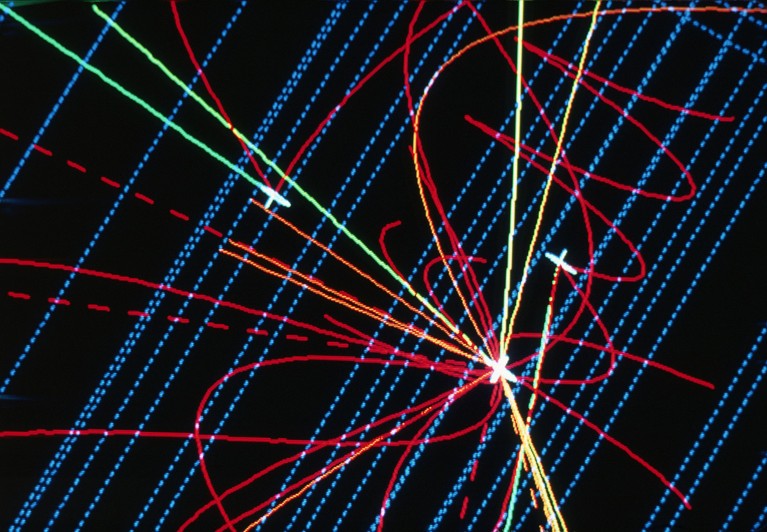

Computer simulation of an electron-positron collision. The blue lines represent part of the detector. The different colored lines are the tracks of particles created in an electron-positron annihilation. The solid lines represent charged particles, which bend in the magnetic field of the detector. The broken lines represent neutral particles, which are not affected by the magnetic field.Credit: Philippe Plailly/Science Photo Library
China hopes to build a $5 billion particle chopper within three years - beating Europe's proposed mega-collider to the punch. The 100-kilometre Circular Positron Electron Collider (CEPC) will aim to measure the Higgs boson - a mysterious particle that gives everything mass - in minute detail. Such information could answer fundamental questions about how the Universe evolved and why particles interact the way they do.
Next year, the CEPC proposal will go before the Chinese government for possible inclusion in its next five-year plan. If it can win government support, construction could begin in 2027 and take about a decade, according to a comprehensive engineering design report published on June 3.1. The report estimates that the large collider would cost 36.4 billion yuan ($5.2 billion), making it significantly cheaper to build and operate than the $17 billion European Future Circular Collider (FCC). Construction of the European facility will begin in the 2030s if it receives government approval.
Inside its vast underground tunnel, CEPC would smash together electrons and their antiparticles, positrons, at extremely high energies to generate millions of Higgs bosons. The sheer number of them would allow researchers to study the particle in more detail than ever before, says Andrew Cohen, a theoretical physicist at the Hong Kong University of Science and Technology. By measuring the Higgs more precisely, researchers will be able to probe questions that reach beyond the Standard Model—the leading but incomplete theory of what the cosmos is made of—such as the nature of dark matter and why it has more ordinary matter than antimatter in the Universe.
Inside the plans for the Chinese mega-collider that will dwarf the LHC
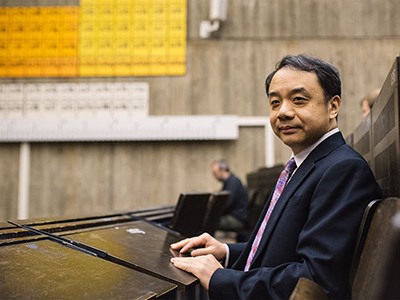
The latest report includes a detailed layout design plan for the accelerator and component prototypes, says physicist Wang Yifang, director of the Institute of High Energy Physics of the Chinese Academy of Sciences in Beijing. It also includes estimates of three potential locations: Qinhuangdao, Changsha and Huzhou. "We are now confident that this is a real machine that we can build," says Wang.
Many of the components planned for China's megamachine are already being tested at other facilities in the country, says Frank Zimmermann, a physicist at CERN, the European particle physics laboratory near Geneva, Switzerland. Among them are the nearly complete High Energy Photon Source in Beijing. Given that China is already home to a collider that is similar to CEPC — the Beijing Electron Positron Collider — the country may now have more expertise in the field than all of Europe combined, says Zimmermann, who chaired the committee's review for the CEPC. technical-design report and is also included in the FCC. "They made great progress," he says.
Help from abroad
The technical design report shows that China is capable of building the CEPC accelerator with a little help from international researchers, says Cohen, a member of CEPC's International Advisory Committee. "If they want to build the accelerator and move forward, they can." But he adds that China will probably have to bring in outside expertise to develop the collider detectors, which were not the focus of the report.
Another hurdle the CEPC may face is attracting funding from other countries in light of ongoing geopolitical tensions, says Tian Yu Cao, a historian and philosopher of particle physics and quantum field theory at Boston University in Massachusetts. . "I think there will be more resistance from the West to help China," Cao says.
CERN's $17 billion supercollider in doubt as major funder criticizes cost
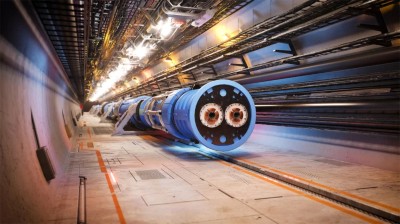
But the challenge of securing international funding is not unique to China. In May, the German government said it would not pay its share of the FCC's $17 billion award, a major setback for the project.
However, Wang is confident that the CEPC will be an international effort. He points out that international researchers already make up 30% to 50% of the teams working at some of China's massive physics facilities — among them the Jiangmen Underground Neutrino Observatory in Kaiping, which will start operating this year. "We believe [the CEPC] it will be similar," he says.
Meanwhile, Wang and his team are working on an engineering design report that will describe the construction of the CEPC in more detail. "We are trying to make sure we are fully ready for such a project," says Wang.
#China #start #building #worlds #largest #particle #collider
Image Source : www.nature.com
Deja una respuesta