As the world strives to decarbonize, it is becoming increasingly clear that we will need to rapidly reduce emissions and actively remove carbon dioxide (CO2) from the atmosphere. The latest report of the Intergovernmental Panel on Climate Change examined 230 ways to keep global warming below 1.5°C. All required CO₂ removal.
Some of the most promising CO₂ removal technologies receiving government funding in the United States, United Kingdom and Australia seek to increase the ocean's massive carbon storage potential. These include fertilizing small plants and changing ocean chemistry.
Ocean-based approaches are gaining popularity because they can potentially store carbon for one-tenth the cost of "direct air capture," where CO2 is absorbed from the air with energy-intensive machinery.
But the marine carbon cycle is much more difficult to predict. Scientists must uncover many complex natural processes that could alter the efficiency, effectiveness and safety of ocean-based CO₂ removal before it can proceed.
In our new research, we highlight a surprisingly important mechanism that was previously overlooked. If CO₂ removal techniques change the appetite of small animals at the base of the food chain, this can dramatically change the amount of carbon actually stored.
Plankton dominates the carbon pump
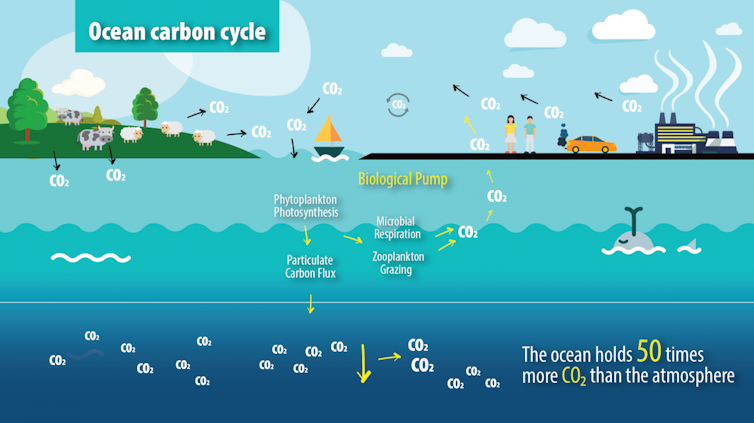
Tiny forms of marine life called plankton play a major role in carbon cycling in the ocean. These microscopic organisms move in ocean currents, moving carbon sequestered across the seas.
Like plants on land, phytoplankton use sunlight and CO₂ to grow through photosynthesis.
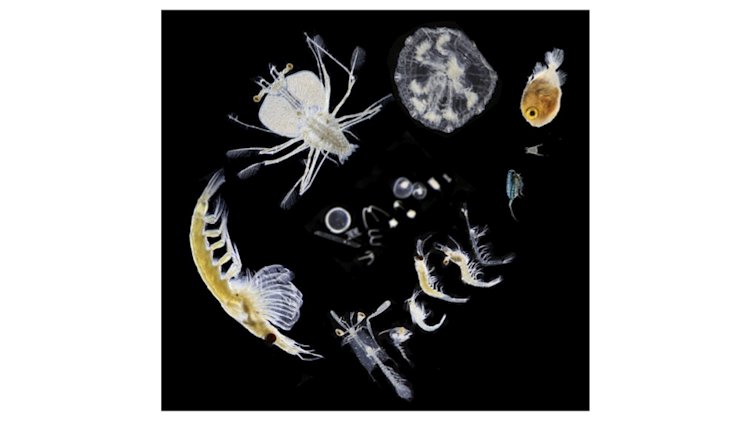
Zooplankton, on the other hand, are small animals that eat mostly phytoplankton. They come in many shapes and sizes. If you put them in a row, you might think they came from different planets.
In all this diversity, zooplankton have very different appetites. The hungrier they are, the faster they eat.
Uneaten phytoplankton – and zooplankton poo – can sink to great depths, keeping carbon locked away from the atmosphere for centuries. Some even sink to the bottom of the sea, eventually turning into fossil fuels.
This transfer of carbon from the atmosphere to the ocean is known as the "biological pump". It keeps hundreds of billions of tons of carbon in the ocean and out of the atmosphere. This translates to about 400 ppm CO₂ and 5°C cooling!
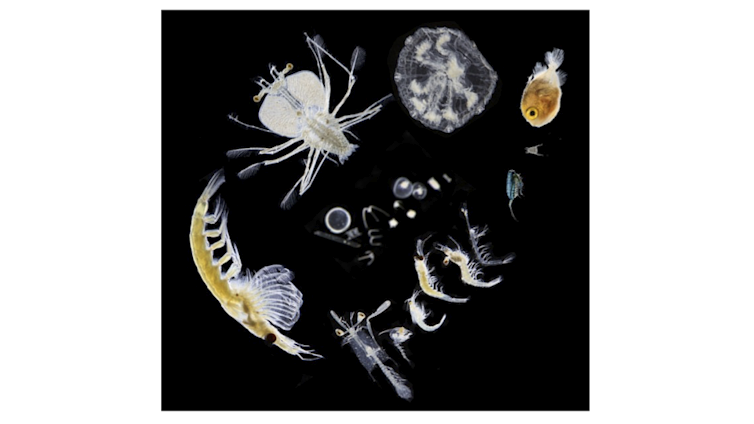
Julian Uribe-Palomino/IMOS-CSIRO
Chosen eaters
In our new research we wanted to better understand how zooplankton appetite affects the biological pump.
First we had to determine how the appetites of zooplankton vary across the ocean.
We used a computer model to simulate the seasonal cycle of phytoplankton population growth. This is based on the balance of reproduction and death. The model simulates reproduction very well.
The appetites of zooplankton largely determine the rate of death. But the model isn't that good at simulating the death rate because it doesn't have enough information about the zooplankton's appetite.
So we tested dozens of different appetites and then checked our results against real-world data.
To obtain global observations of phytoplankton seasonal cycles without a fleet of ships, we used satellite data. This is possible even though phytoplankton are small, because their light-catching pigments are visible from space.
We ran the model at more than 30,000 sites and found that zooplankton appetites vary wildly. This means that all those different types of zooplankton are not spread evenly throughout the ocean. They seem to congregate around their favorite types of prey.
In our latest research, we show how this diversity affects the biological pump.
We compared two models, one with only two species of zooplankton and another with an unlimited number of zooplankton – each with different appetites, all individually adapted to their unique environment.
We found inclusion of realistic zooplankton diversity reduced the biological pump power of one billion tons of carbon each year. This is bad for humanity because most of the carbon that doesn't go into the ocean ends up back in the atmosphere.
Not all of the carbon in phytoplankton bodies would have sunk deep enough to be locked away from the atmosphere. But even if only a quarter were, once converted to CO₂ that could match the annual emissions from the entire aviation industry.
IAEA
The ocean is like a sponge
Many ocean-based CO2 removal technologies will alter phytoplankton composition and abundance.
Ocean-based biological CO₂ removal technologies such as "ocean iron fertilization" aim to increase phytoplankton growth. It's a bit like spreading fertilizer in your garden, but on a much larger scale – with a fleet of ships planting iron across the ocean.
The goal is to remove CO₂ from the atmosphere and pump it into the deep ocean. However, because some phytoplankton desire more iron than others, feeding them iron can change population composition.
Alternatively, non-biological ocean-based CO₂ removal technologies such as “ocean alkalinity enhancement” alter the chemical balance, allowing more CO₂ to diffuse into the water before it reaches chemical equilibrium. However, the most accessible sources of alkalinity are minerals, including nutrients that promote the growth of certain phytoplankton over others.
If these changes in phytoplankton favor different species of zooplankton with different size appetites, they are likely to alter the strength of the biological pump. This could compromise – or complement – the efficiency of ocean-based CO₂ removal technologies.
Moving forward from a sea of uncertainty
New private sector CO₂ removal companies will seek accreditation from credible carbon offset registries. This means they must demonstrate that their technology can:
- removes carbon for hundreds of years (perpetuity)
- avoid major environmental impacts (safety)
- be suitable for accurate monitoring (verification).
Faced with a sea of uncertainty, now is the time for oceanographers to set the necessary standards.
Our research shows that CO₂ removal technologies that alter phytoplankton communities can also induce changes in carbon storage, modifying the appetite of zooplankton. We need to better understand this before we can accurately predict how well these technologies will work and how we should monitor them.
This will require tremendous efforts to overcome the challenges of observing, modeling and predicting zooplankton dynamics. But the payoff is huge. A more credible regulatory framework could pave the way for a growing, trillion-dollar, morally imperative CO₂ removal industry.
Deja una respuesta