Webb's observations point to a giant asteroid impacting a nearby planetary system
"James Webb Telescope: Are We Alone?" in The Whole Story With Anderson Cooper offers an inside look at the most powerful telescope ever built. The show premieres Sunday, June 16 at 8:00 PM ET/PT on CNN.
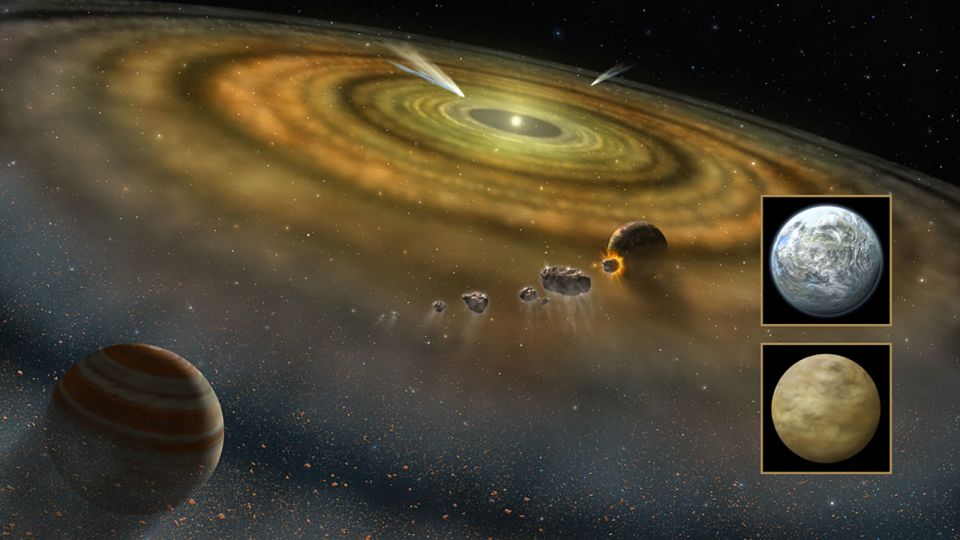
A collision between giant asteroids may have occurred in a neighboring star system called Beta Pictoris in recent years, and two different space observatories are helping to tell the tale.
The Beta Pictoris system, located just 63 light-years from Earth, has long intrigued astronomers because of its proximity and age.
While our solar system is estimated to be about 4.5 billion years old, Beta Pictoris is considered a "teenage planetary system" at 20 million years old, said astronomer Christine Chen, a research scientist at Johns Hopkins University in Baltimore who has observed the system of multiple. times.
"That means it's still forming," she said during a presentation at the 244th Meeting of the American Astronomical Society in Madison, Wisconsin, on June 10. "It's a partially formed planetary system, but it's not done yet."
Chen observed Beta Pictoris, which has two known gas giant planets called Beta Pictoris b and c, using the now-retired Spitzer Space Telescope in 2004 and 2005. At the time, Chen and her colleagues saw several different populations dust inside the system.
"So I was very excited to re-observe this system in 2023 using the James Webb Space Telescope," Chen said. "And I was really hoping to understand the planetary system in much greater detail, and we're definitely doing that."
Since Webb opened its infrared eye to the universe in 2022, scientists have used the space observatory to peer through gas and dust to study supernovae, exoplanets and distant galaxies.
By comparing the Spitzer and Webb observations, Chen and her colleagues realized that the data they captured 20 years ago happened at a pretty terrible time—and two of the main dust clouds had since disappeared.
Chen is the lead author of a study comparing the observations that was presented Monday at the conference.
"Most of the discoveries from JWST come from things the telescope has detected directly," study co-author Cicero Lu, a former Johns Hopkins doctoral student in astrophysics, said in a statement. "In this case, the story is a little different because our results come from what JWST didn't see."
The team believes the Spitzer data hint that a pair of giant asteroids collided shortly before the telescope's observations of the system.
"Beta Pictoris is at an age when planet formation in the terrestrial planet zone is still ongoing through giant asteroid collisions, so what we can see here is essentially how rocky planets and other bodies are forming in real time ,” Chen said.
Evidence of a giant collision
When Chen and her team observed Beta Pictoris between 2004 and 2005, they were likely seeing evidence of an "actively colliding planetary system," but they just didn't understand it yet, she said.
In addition to the two known planets, previous searches have revealed evidence of comets and asteroids orbiting the new system.
As comets and asteroids collide, they create dust debris and help form rocky planets.
The collision that occurred shortly before Spitzer's observations likely pulverized a massive asteroid into tiny dust particles that were smaller than pollen or powdered sugar, Chen said.
She said the mass of dust created was about 100,000 times larger than the asteroid that killed the dinosaurs, which was estimated to be between 6.2 and 9.3 miles (10 and 15 kilometers) across. The dust was then pushed out of the planetary system by radiation from the central star, which is slightly hotter than our sun.
At first, astronomers thought that the small bodies were colliding and replenishing the dust clouds seen in Beta Pictoris over time. But the powerful Webb telescope was unable to detect any dust.
Although gas giant planets have formed in the system, rocky planets are likely still forming.
Astronomers plan to make more observations of the system to see if more planets appear. Meanwhile, studying the system can help astronomers better understand what the early days of our solar system looked like.
"The question we're trying to contextualize is whether the entire formation process of terrestrial and giant planets is common or rare, and the even more fundamental question: Are planetary systems like the solar system that rare?" study co-author Kadin Worthen, a doctoral student in astrophysics at Johns Hopkins, said in a statement. "We're basically trying to figure out how weird or average we are."
Sign up for CNN's Science of Miracles newsletter. Explore the universe with news of fascinating discoveries, scientific advances and more.
For more CNN news and newsletters, create an account at CNN.com
#Webbs #observations #point #giant #asteroid #impacting #nearby #planetary #system
Image Source : www.yahoo.com
Deja una respuesta